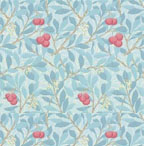
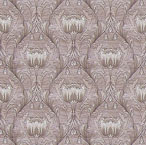
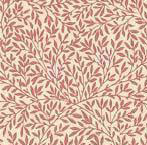
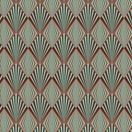
JENNIFER'S FREE PRINTABLE DOLLHOUSE WALLPAPER

ART NOUVEAU


go to aart nouveau001

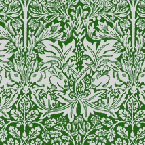
William Morris

HERE ARE THE SAMPLES OF

ART NOUVEAU DOLLHOUSE WALLPAPER

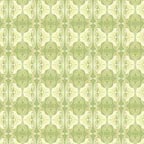
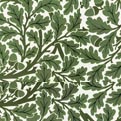
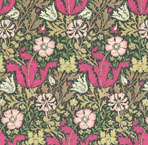
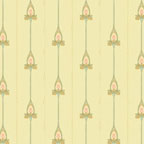
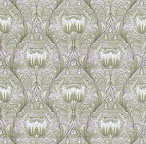
There are 11 wallpapers in this category.If you find a wallpaper you like, click on the sample. Clicking the sample will bring up a full 8 inch x 10 inch page of the dollhouse wallpaper.

Art Nouveau (c.1880 to 1910)

Art nouveau could be said to be the first 20th century modern style. It was the first style to stop looking backwards in history for ideas, taking inspiration instead from what it saw around it, in particular the natural world.
When art nouveau was showcased first in Paris and then in London, there was outrage; people either loved it or loathed it. Within the style itself there are two distinct looks: curvy lines and the more austere, linear look of artists such as Charles Rennie Mackintosh. Some aspects of art nouveau were revived again in the 1960s.

From www.bbc.co.uk/homes


Get the Look

Get the look is meant for real size houses. The same rules apply to dollhouse rooms though, so I have included it here.

Floors - are parquet and should be stained and varnished. Colour schemes - are quite muted and sombre and became known as 'greenery yallery' - mustard, sage green, olive green, and brown. Team these with lilac, violet and purple, peacock blue. Mackintosh experimented with all-white interiors.

Walls - can either be painted in one of the colours of the palette or off-white, or papered.

Wallpaper - designs are highly stylised flowers, particularly poppies, water lilies and wisteria; branches, tendrils, leaves, stems, thistles, pomegranates; peacock feathers, birds and dragonflies.

Style -sinuous, elongated, curvy lines the whiplash line vertical lines and height stylised flowers, leaves, roots, buds and seedpods the female form - in a pre-Raphaelite pose with long, flowing hair exotic woods, marquetry, iridescent glass, silver and semi-precious stones

Influences
arts and crafts - art nouveau shared the same belief in quality goods and fine craftsmanship but was happy with mass production rococo style botanical research

From www.bbc.co.uk/homes


The Arts and Crafts Movement

In England and then America in the late 19th century, a middle class revolution occurred against Victorian values, industrialization and the mass production of low-quality products. Originally a British movement whose roots can be traced back to the early 1800's, the social and moral preachings of people such as John Ruskin and William Morris in the late 1800's influenced the burgeoning what would be known as the Arts and Crafts Movement.

The philosophy behind the Arts and Crafts Movement was recognition that technology, or industrialization, did not equate to a higher quality of life for individuals. The Arts and Crafts Movement believed that the degradation of social values, which was evident through poor working conditions, poverty and the exploitation of workers, was caused by wide-spread industrialization .

By 1880, the Arts and Crafts Movement became the symbol for the "liberal middle class". The movement strove to make art affordable to all people, create better working conditions, and influence a climate where artists who ranged from architects to those involved in the fine arts, were free to be creative.

In the new society which the Arts and Crafts Movement hoped to influence, artists could design and create each piece of work from start to finish. Pieces would be hand-made and of the best quality.

Ironically, by the end of the Arts and Crafts Movement in the first quarter of the 20th century, the products of the movement became so expensive that only the wealthy could afford them.

University of Victoria
Maltwood Art Museum


go to art nouveau002
go to aart nouveau003

go to art nouveau004


go to aart nouveau005

go to art nouveau006

William Morris

go to art nouvea007

William Morris

go to art nouveau008

William Morris

go to art nouvea009

William Morris

William Morris

go to art nouvea011

William Morris


Charles Voysey


M.P Verneuil c 1896

Charles Voysey


Lindsay Butterfield


Build a Professional Looking Website with 

Homestead.com.

You don't have to be a ''techie type person'' to use Homestead Site Builder. Homestead takes care of ALL the complicated stuff. If you do happen to get stuck, and need help, you can phone or email the Homestead support staff, they are really pleasant and helpful. You can try it out yourself for FREE! Just click the the Homestead button above.

Build a Website in Minutes. Try for free!


Designers from the Art Nouveau and Arts and Craft Movement
William Morris (1834-1896)

William Morris was one of the most influential voices in Victorian art and architecture, and his influence spread far into the 20th century in the form of the Arts and Crafts Movement that he helped spawn. There was a profound social philosophy behind Morris' designing. He was a committed socialist and medievalist who was horrified by increasing mechanization and mass-production in the arts, and he dreamed of reestablishing the values of traditional craftsmanship and simplicity of design. His slogan was that art should be "by the people, for the people"

from.

www.britainexpress.com

Charles Francis Annesley Voysey (1857 - 1941)

Charles Francis Annesley Voysey was an English architect, designer and typographer. He articled with architects J.P.Seddon and George Devey, and then opened an office of his own in 1882, concentrating on wallpaper and fabric designs rather than architecture. He designed his first house in 1888, and in 1900 built his own home "The Orchard" designing much of the furniture, decoration and fittings. His characteristic simple architectural style was highly influential, and was copied widely. In all he designed around 150 houses, and designed decorative arts products, including wallpaper, textiles and carpets for a variety of British firms.

from


charlesrupert.com

Lindsay Philip Butterfield, (1869-1948)

After training at the South Kensington National Art Training School, Butterfleld became a freelance designer of wallpapers and textlles. Butterfield sold designs to G P & J Baker, Warner & Sons, Thomas Wardle, Turnbull & Stockdale, Alexander Morton Newman, Smith & Neurman and David Barbour. He taught at a number of art schools and was a founder member of the Society of Designers.


from


victorianweb.org


Louis Comfort Tiffany (1848-1933)

Louis Comfort Tiffany (1848-1933) Louis Comfort Tiffany was one of the greatest of the American artists making glass, pottery, jewelry, enamel on copper, and other salable works of art. He was born in New York City and studied art in New York and Paris. For a time he remained in Europe, painting oils and watercolors. Among his most outstanding paintings is Snake Charmer at Tangiers (1915?, Metropolitan Museum, New York City). Returning to New York he turned his attention to media other than paints.
The Tiffany metal furnaces of Corona, NY, were started in 1898 and experiments in making pottery began the same year. Tiffany added shades to wide-mouthed ceramic vases purchased from Grueby and other leading art potteries. He continued to purchased ceramics even after Tiffany studios established its own ceramic division in 1905. That same year his firm began to make lamp bases for his Favrile glass shades. The bases were deep ivory-shaded brown. Later bases were green, and a few white or coated with bronze. Many had matte glazes. All were marked "LCT" on the bottom. The pottery bases were only a limited success, and most of the lamp bases made by Tiffany were of enameled metal rather than pottery.
He established a glassmaking factory and experimented with stained glass for decorative-art objects. He invented a process for making an opalescent glass, known as Tiffany favrile glass, which he used to fashion colorful windows, vases, lamps, and other decorative-art objects. Much prized by collectors today, the pieces are characterized by the curved and delicate lines of the art nouveau style.

from

anc.gray-cells.com


According to statistics found in an 1879 issue of The Furniture Gazette, an article related that

"The people of the United States spend $8,000,000 per annum for wallpaper, their requirements being about 57,142,860 rolls or about 457,142,400 yards."

The article also indicated that during this same year the retail price for wallpaper was 25 cents a roll. By these figures, it is clear that wallpaper manufacturing was a major industry in 1860's--1870's America.

from


www.historybuff.com

More Printables

back to wallpaper menu


Get decorating

Getdecorating has more than 12,000 photos of actual homes designed, decorated and landscaped by Interior Designers and Architects throughout North America. This is the best place on earth to find home design and decorating ideas.

Getdecorating has more than 12,000 photos of actual homes designed, decorated and landscaped by Interior Designers and Architects throughout North America.

There’s no site like it! Get decorating


Home Decorating How-To's

In decorating there are few, if any, rules. Instead there are general principles or "Rules of Thumb" that decorators use to guide their decisions. Select from our list of How-To's to learn more about how you too can use these guidelines to create beautiful rooms

Home Decorating How-To's


back to wallpaper menu

View my other websites